Artificial Intelligence
Ancient ideas about creating an artificial human differed from modern ones in one important respect: they always contained an element of the unknowable that allowed for the possibility of “breathing a soul” into the creation. That element might be love, as in the myth of Galatea, magic spells, or the water of life; even purely mechanical beings were either set in motion by some unknown force or made by a deity itself. But with the arrival of the age of mechanistic materialism, when many devices stopped being simple tools and acquired certain elements of logic and algorithm — clocks, music boxes, clockwork toys — inventors for the first time began to think seriously about the real possibility of creating not so much the body of an artificial human as its mind, and even its soul. And from then on humanity was gripped by a deep-seated fear of everything that comes with such ideas; its source was the ancient myth of those who encroached on divine prerogatives and wished to become equal to God. In various forms, this myth existed not only in the Bible but in practically every religion. If you turn to fiction about the creation of an artificial human, you can trace a clear pattern: the less the story allowed for the possibility of “breathing a soul” into the man-made being at the moment of its creation, the more tragic the ending the author chose. The tale of Pinocchio ended well only because Geppetto carved him from a log that was already alive — which is more than can be said for Frankenstein’s creature, the Homunculus in Goethe’s “Faust”, or the ancient Golem.
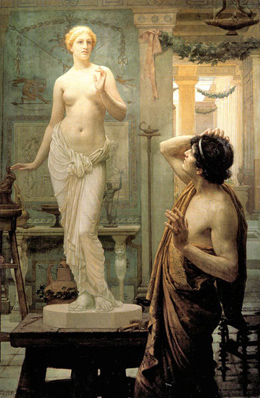
Aphrodite heard Pygmalion’s prayers and brought Galatea to life from the statue. In the myth, the life-giving force is divine, so the mystery of creating a human is preserved and there is no encroachment on divine prerogatives

Pinocchio. Geppetto made him from a log that was already alive, so he already had a “soul” — Geppetto merely gave it a shape
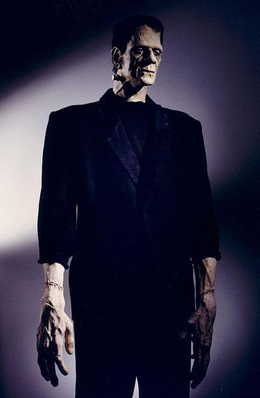
In Mary Shelley’s novel, Victor Frankenstein, a young student from Geneva, uses “scientific” methods to bring to life a human likeness assembled from parts of dead bodies. The revived monster begins to take revenge on its creator. Consciously or not, the author “punishes” the hero for wanting to be like God
Der Golem, wie er in die Welt kam, 1920.
Der Golem, wie er in die Welt kam, 1920. A film based on the Jewish folk legend of an artificial man (the “golem”). The plot is similar to the Frankenstein story. The soulless creature likewise rebels against its creator
Today, thoughts about artificial intelligence are no longer the preserve of a few science-fiction writers; they occur quite naturally to practically everyone living in a computerised civilisation. Building devices that can “think” has become a profession, and the conflict between artificial intelligence and the Bible has taken on a new life. A concept has emerged that reconciles the two. It rests on these words of Scripture: “So God created man in his own image …”. From this one can conclude that since God, first, created us and, second, we are like Him in our essence, He also gave us the ability to create someone in the image and likeness of a human. Logical as this argument is, the tension around the issue keeps growing. The theme of “machines in revolt” has become a downright obsession of modern cinema. “The Terminator”, “The Matrix”, “I, Robot” and countless lesser-known films express the fears of modern society quite clearly.
Sarah Connor’s dream. The end of humanity
“The Terminator”. The machines have risen against humans
“The Matrix” trilogy. Humanity’s unconscious fear of a machine mind in revolt.
Still, this process can hardly be stopped, and there will certainly be a continued search both for new technologies and for solutions to the ethical problems that come with them — rules, principles, safety laws. Such laws were proposed by the science-fiction writer and scientist Isaac Asimov: 1. A robot may not injure a human being or, through inaction, allow a human being to come to harm. 2. A robot must obey the orders given to it by human beings, except where such orders would conflict with the First Law. 3. A robot must protect its own existence as long as such protection does not conflict with the First or Second Law.
We don’t yet know how justified this fear is or how real the danger of rebellious machines may be, but it’s worth remembering that heliocentrism, the roundness of the Earth and the number of ribs a man has once caused no less trouble, and all of these questions are settled today, while autopsies and organ transplants no longer provoke the stormy protests they once did — not even from the Church. Time will tell.
AI research also has a positive ethical side: willingly or not, it helps people understand themselves — the principles they live by and the algorithms of their thinking. Above all, it will help people stop “being robots” themselves. Psychology and sociology, in studying humans, often find such simple laws in their behaviour that one might think they are describing automatons rather than people. K. Marx, F. Engels, S. Freud, C. Darwin and many other scholars of the late 19th and early 20th centuries presented the deepest phenomena of human nature as metamorphoses of the simplest fundamental algorithms. In their theories, the psyche, culture and intellect are seen merely as tools for carrying out those algorithms. So from this point of view a human is no different from a “machine”, except that the machine solves tasks set by humans, while humans solve the primary tasks set by nature. Darwin, for instance, considered survival and evolution to be such a primary task, which implied that intelligence, love and all human feelings are products of natural selection — that is, the most practical way to survive. Freud derived the basic mechanism for carrying out the primary task: the “pleasure principle”. It is an algorithm of “drive”: according to it, every living thing relates the events it perceives to its primary tasks (survival of the individual and survival of the species); if an event makes these tasks more likely to succeed, the individual feels pleasure, and if the opposite, suffering. The more an object or event helps satisfy these drives, the more strongly the individual strives for it and the more pleasure it feels when it “gets” it. This principle is widely used in AI design. A program defines a certain “happiness” score and calculates its value for every possible move. The program picks the option with the highest “happiness”. In draughts, for example, the goal is to take the opponent’s pieces, so you could say the program “feels more pleasure” from a move that captures a piece, and even more from a move that crowns a piece as a king, since that will let it capture even more.
Freud also demonstrated the so-called determinism of the psyche — in other words, the strict order of each of its elements. He carried out many studies and concluded that a person is incapable of coming up with anything random — no number, word or image: they always turn out to be connected and even express, most vividly, what the person is thinking at that moment. When people try to come up with something random, they name the element that most precisely sums up all the processes going on in their psyche. This idea of Freud’s indirectly reinforced the view of the human as a machine (whether created by God or produced by evolution). It followed that since a person cannot invent anything random, they only do what nature has built into them and have no freedom. Modern computers likewise cannot produce a truly random number: they use a sequence of pseudo-random numbers, so what you get is not randomness but unpredictability.
So what happens if we try to compare a modern computer with a human
The difficulty of the comparison is that they are built on fundamentally different designs from the start. (We should also bear in mind that 99.9(9)% of operations in the human psyche happen unconsciously.) In a computer, all impulses are synchronised by the central processor, so at any given moment it can perform only one operation. This is the so-called sequential model: all operations are executed in turn, one after another. The brain, on the other hand, is a parallel structure, and it is better compared not to one computer but to an assembly of millions of computers — neuron cells, each of which can carry out its own operations independently. But millions of processes are not yet the equivalent of a brain — or rather, they are, but of the spinal cord rather than the brain. The brain is structured into “centres”: it is an assembly of several hundred networks, each coordinated by several duplicate “processor neurons”. Overall, the brain is distinguished by multiple duplication and redundancy of information, which gives it enormous operational stability. Unlike a modern computer, damage to individual neurons has almost no effect either on the mind as a whole or on any single block of it; damage to control neurons affects the work of one of the mind’s blocks, and complete damage to the neurons of a centre shuts the corresponding block down entirely. Some centres and their blocks are not essential to the mind’s functioning (a blind, deaf and mute person can think just as well as anyone else), while others are essential (memory, abstract thinking). The block structure of the brain can, to some extent, be compared to the functional boards in a computer. For example, rendering an image on screen is handled by a so-called video adapter, which already has built-in algorithms for computing geometric shapes, polygonal surfaces and so on. Computing methods in a computer can be divided into software and hardware. The first relies exclusively on the general-purpose resources of the central processor; the second can be used when there is a dedicated physical device for a particular kind of computation — to put it simply, a separate device for calculating the area of a shape, a separate device for calculating colour, and so on (a video adapter, a sound card, a video-editing board). Because the hardware method is narrowly focused and optimised for exactly that task, it is many times more powerful and faster than the general-purpose software method. The brain’s computing methods are closer to the hardware approach. For instance, the neurons of the centre responsible for human communication form in childhood. You could say that for each language a child grows special microchips, which is exactly why children find languages so easy to learn. An adult, however, has to use the software method and run all the information about a language through consciousness (to some extent the equivalent of a computer’s central processor). For the same reason, people who write with flawless spelling and grammar usually don’t remember the rules, and they are in many ways ahead of those who try to apply a “logical” method. There are countless examples where algorithms “hardwired” into the brain outperform rational approaches: portrait painters, animators and poets unconsciously carry out calculations of enormous power and depth that are beyond the reach of logicians. Animators who use 3D computer modelling and physical and mathematical calculations still cannot capture the nuances of character movement that animators of years past achieved by relying on nothing but their own feel, and from the very first frames the choppy motion of computer cartoons “jars on the eye”.
Whether to identify the human mind with the brain, and whether to believe that subtle matter takes part in thinking, is a separate question and a purely personal one for each of us; but regardless of one’s beliefs, it can be stated beyond doubt that the brain is the computing instrument of thought. When certain areas of it are damaged, a person loses the ability to do the mental work associated with those areas: recognising faces, reading, analysing and so on. Thanks to the electrochemical nature of neural signals, the correspondence between mental activity and different areas of the brain can be observed with special instruments.
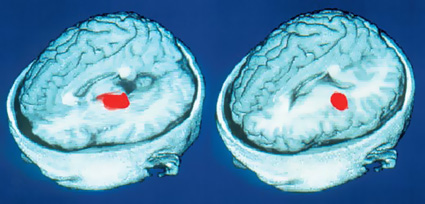
Brain areas (red) involved in verbal learning. On the left, the area responsible for memorising the word itself; on the right, for retaining its meaning
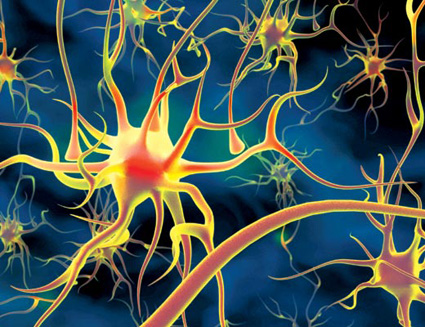
A neuron is essentially an elementary processor
Let’s try to estimate the power of the human brain in computer terms. It consists of roughly 100 billion neurons. Each neuron is a miniature “processor” connected to other neurons through 5000 synapses. Because information is transmitted chemically, a neuron needs about 0.01 s to recover. So a neuron’s operating frequency is about 100 Hz. Each synaptic signal can be estimated at roughly 5 bits. This gives one neuron a power of 1000000 ops/s. For the whole brain, 10^17 ops/s. Today an average home computer delivers 10^9 ops/s, and the most powerful computers in the world about 10^13 ops/s, which is still 10 thousand times less than the power of the human brain. Bear in mind that a simple comparison of computing power cannot characterise the effectiveness of intelligence. The human brain has an extraordinarily optimised organisation and the ability to use the experience of previous generations, to learn by itself and to restructure itself. To appreciate the performance of the human visual system alone, it’s enough to recall that every sixteenth of a second it analyses images thousands of times higher in resolution than the most advanced cameras. In that time the brain manages to pick out individual objects, relate them to past experience, assign them to particular groups, match the information from the left and right eyes, use it to calculate the distance to each object, and direct the pupil to the most effective point for the image being examined. You can read more about memory capacity, for example, in Shumilov’s work “The Information Capacity of the Human Brain”.
Conclusion
Not so long ago, the phrase “Scientists have calculated on a computer that …” sounded like a magic spell guaranteeing that a statement was beyond dispute. People believed that if a computer had had a “hand” in the calculations, then behind its output lay something superhuman, beyond the understanding of mere mortals. It seemed that a matchmaker computer could find the perfect husband or wife, and an oracle computer could reliably predict the future. Later, of course, once computers became part of everyday life and every schoolchild had in their pocket, on top of a phone, a computer more powerful than whole computing departments of the 1970s, everyone realised that it would never give out more than had been put into it. The literal comparison of computer and brain performance above has no real significance, except to show that the computer still lags far behind the brain even in raw power. Besides, I wouldn’t put an equals sign between the mind and thinking. But where comparing them does, in my view, prove truly useful and convenient is in describing the dynamic processes of human thinking. The thing is, many abstract phenomena and the concepts related to them had no verbal expression in language before computers appeared. Take the term “data caching”. You could, of course, describe this process in a few sentences, but how much more clearly you can express the idea using a term from computing! Thinking processes are often described with spatial and temporal categories, with analogies of little boxes, flasks and threads, which aren’t enough to fully express concepts when we’re dealing not with static but with dynamic phenomena inherent in mental activity. It seems to me that images from computing are the most convenient for describing this area. Comparing mental activity to cybernetic activity in no way obliges us to conclude that we, or our minds, are computing machines: it’s simply that the computer today is one of the most complex — and, moreover, most widespread — devices we have, and it illustrates concepts better than drawers and little boxes do.